
Dignity and the Missing Occupation
8/31/2026
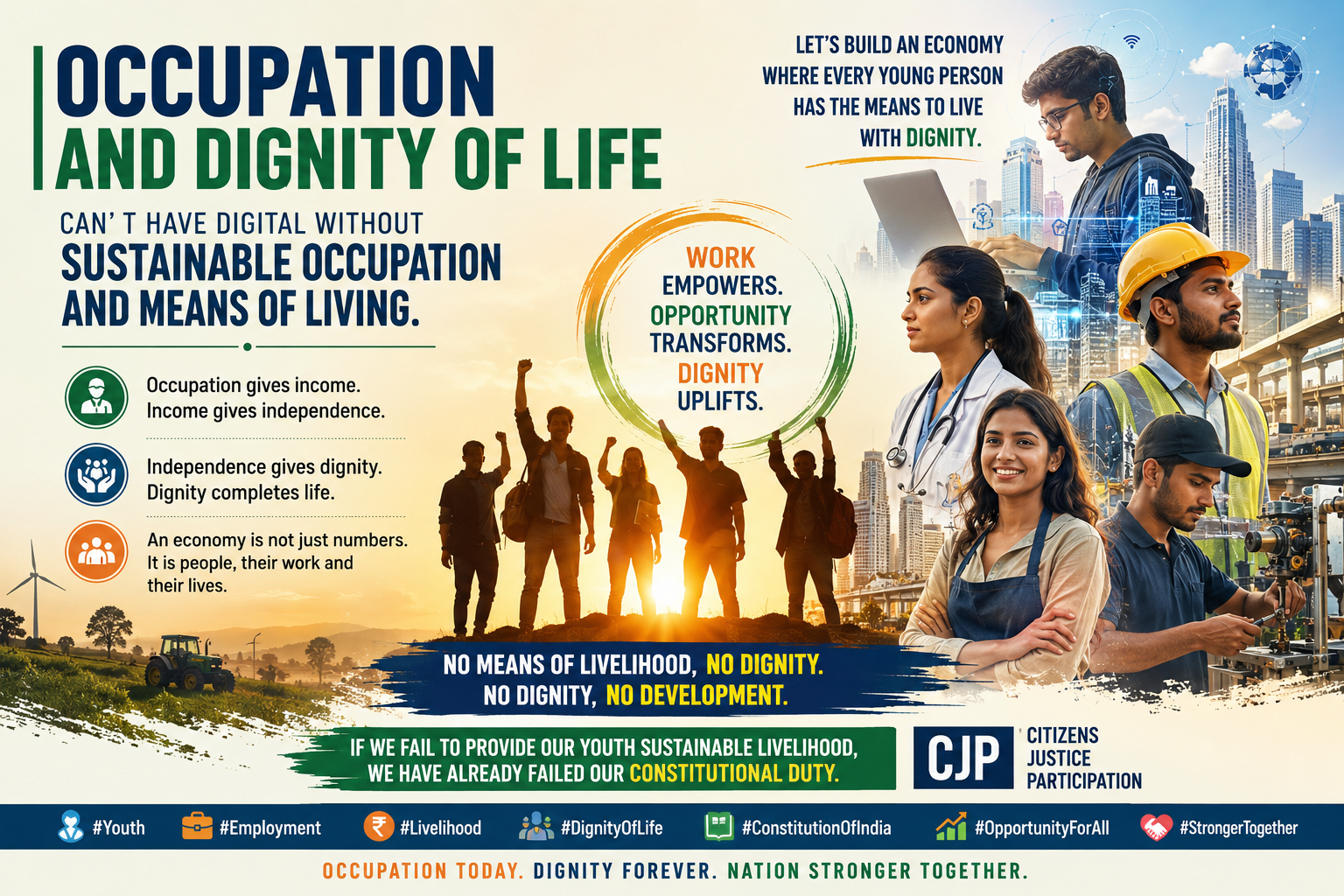
We often speak of building a digital economy, becoming a global economic power, creating startups, expanding infrastructure and becoming one of the world's largest economies. We celebrate GDP, investment, market capitalisation, digital transactions and technological progress. All of these matter. But beneath every economy is something much more fundamental: people must have a meaningful and sustainable means of living.
Without occupation, livelihood and economic participation, the language of dignity becomes incomplete.
A person who has education but no opportunity to apply it, skills but no market for those skills, ambition but no pathway to earn, or the willingness to work but no sustainable work available is not fully participating in the economy. They may technically be counted somewhere in an economic statistic, but their lived experience can remain one of exclusion.
This is particularly important for the youth.
India's Constitution did not conceive economic development merely as an increase in national wealth. Article 39 directs the State towards securing adequate means of livelihood for citizens and preventing the concentration of wealth and economic power to the common detriment. It also specifically speaks of protecting youth from exploitation and material abandonment.
Article 41 goes further, directing the State, within the limits of its economic capacity and development, to make effective provision for the right to work, education and public assistance in cases including unemployment. Article 43 speaks of work, a living wage and conditions ensuring a decent standard of life.
These are Directive Principles, not individually enforceable guarantees of a particular job or income. But they represent a constitutional philosophy: economic development is ultimately supposed to serve human beings.
That raises an uncomfortable question: are we sufficiently successful at turning economic growth into broad-based economic participation?
The official numbers do show improvement. India's PLFS 2025 reported an overall unemployment rate of 3.1% for persons aged 15 and above, while youth unemployment among those aged 15–29 was 9.9%, down from 10.3% in 2024. Urban youth unemployment remained considerably higher, at 13.6%.
These numbers should not simply be dismissed. Employment statistics are valuable and improvements should be acknowledged.
But unemployment alone is not the complete measure of economic dignity.
There is a profound difference between having work and having sustainable work.
A person may be working but earning too little to live independently. Another may be self-employed because there is no alternative. Someone else may have a degree but be trapped in work unrelated to their education. A young person may spend years preparing for competitive examinations because the formal employment system offers too few attractive pathways. Another may repeatedly enter short-term, informal or unstable employment without building assets, skills or long-term security.
Therefore, the question should not simply be: How many people are employed?
It should also be:
How many people can build an independent life through their occupation?
That is the missing dimension in much of our economic conversation.
A healthy economy should create pathways from education → skills → occupation → income → savings → assets → independence → dignity.
If that chain breaks at occupation, the rest becomes fragile.
Digitalisation cannot repair this problem by itself. A country can have excellent digital infrastructure, instant payments, artificial intelligence, e-commerce and sophisticated financial technology while millions remain economically disconnected from productive opportunities.
Technology is an amplifier. It can amplify opportunity, but it can also amplify concentration.
The responsibility therefore cannot rest entirely with government. Public institutions, private corporations, universities, banks, entrepreneurs, investors, local governments and civil society all have roles to play.
The private sector must create productive enterprises rather than merely extracting value from existing markets. Government must create predictable institutions, infrastructure and incentives for employment-intensive investment. Universities must become better connected to actual economic demand. Vocational education must acquire genuine market value. Small businesses must receive easier access to finance, technology and markets. Young people must be given opportunities to participate not merely as consumers, but as producers, entrepreneurs, professionals, researchers, creators and citizens.
And perhaps most importantly, the public must be invited into the economy rather than merely measured by it.
When enormous public and private institutions exist alongside a large educated youth population, yet many young people cannot see a credible pathway from their education and effort to economic independence, something is structurally wrong.
This is not an argument against economic growth. It is an argument for better growth.
GDP matters because resources matter. Investment matters because capital creates productive capacity. Infrastructure matters because it lowers economic costs. Digitalisation matters because it can reduce transaction costs and expand access.
But these are means, not the final objective.
The final objective must be an economy in which ordinary people can participate meaningfully and build lives with security, agency and dignity.
We should therefore stop treating youth merely as a demographic advantage. Youth are economic participants whose productive potential must actually be realised.
A young person who spends their most productive years searching for an opportunity is not merely experiencing a personal setback. The economy is losing their productivity, creativity, consumption, entrepreneurship, family formation, tax contribution and social participation.
That is an opportunity cost borne by the entire nation.
India may become the world's third-largest economy. It may eventually become the world's largest economy. Those achievements would be historically significant.
But economic size alone cannot be the definition of national success.
If millions of citizens remain unable to find sustainable occupations through which they can support themselves, develop their capabilities and participate with dignity, then something fundamental remains unfinished.
The real test of an economy is not merely how large it becomes, but how many people can find a meaningful place within it.
And if we fail to provide our youth with sustainable means of livelihood, we should have the humility to recognise that the failure exists before the statistics tell us otherwise.
Because an economy is ultimately not a number.
It is people living their lives.
And dignity cannot be permanently sustained without the means to sustain life itself.