
The Futile Pursuit of Equality
8/31/2026
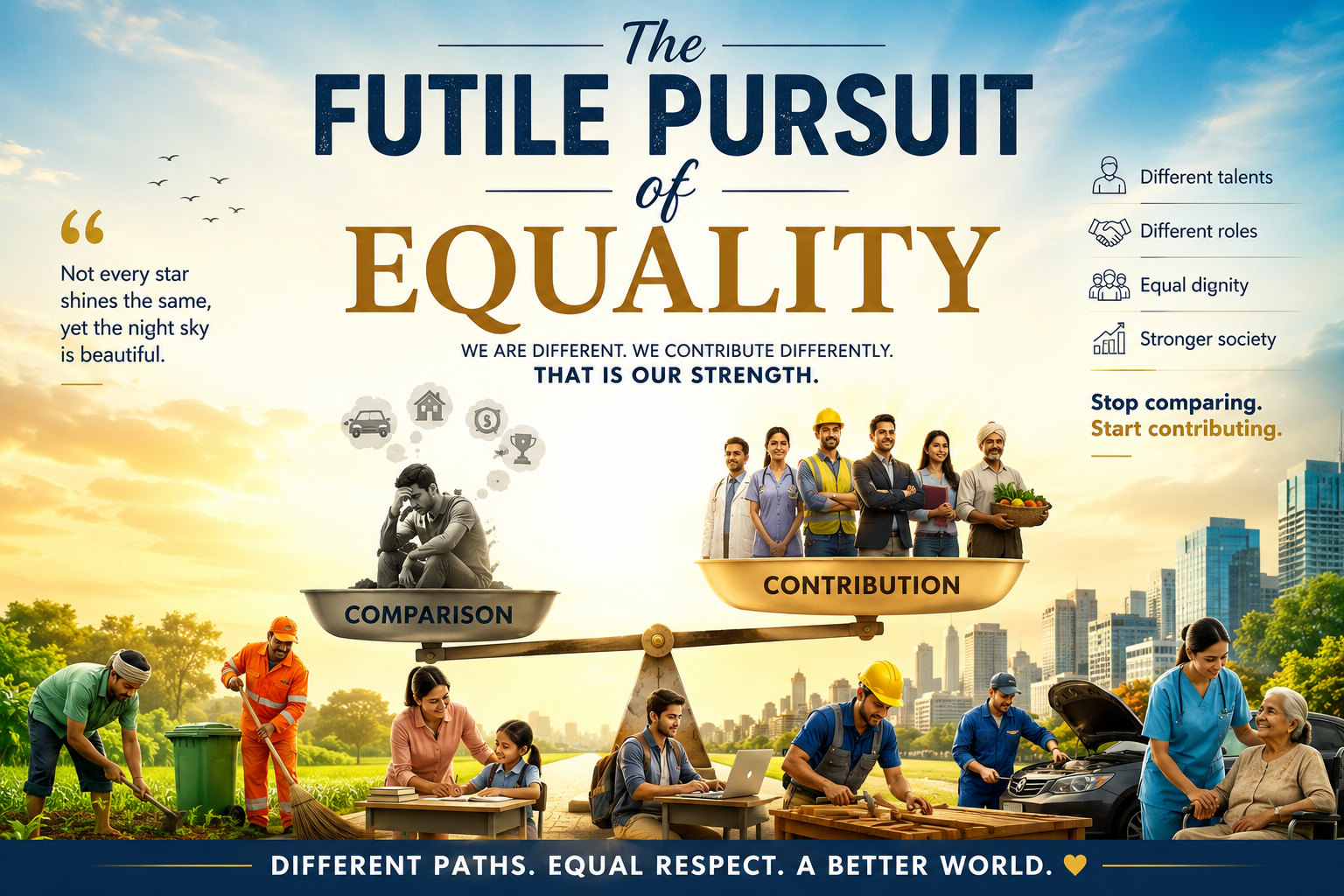
Are we becoming so obsessed with equality that we are forgetting the value of difference?
Equality is undoubtedly a noble ideal when it means equal dignity, equal protection under the law, freedom from discrimination, and a fair opportunity to improve one's life. But the pursuit of making people equal in every respect is neither realistic nor necessarily desirable. Inequality, in some form, is an unavoidable feature of human existence and, when properly understood, can be the foundation of a functioning society and economy.
Consider the ancient story of Cain and Abel. One brother's offering is accepted while the other's is not. Cain perceives the difference as an injustice. His comparison with Abel produces resentment, and that resentment ultimately leads to violence. The story may be ancient, but the psychology behind it remains remarkably relevant.
Perhaps inequality itself is not always the problem. Our inability to accept another person's advantage over us can be.
Human beings are unequal from birth. We possess different talents, temperaments, physical abilities, intelligence, interests and circumstances. One person may be gifted in mathematics, another in music, another in craftsmanship, another in leadership and another in caring for people. Even children raised in the same family can develop completely different abilities and personalities.
Society has always depended upon these differences.
Imagine a kingdom in which everyone is a king. Who would grow the food? Who would build the roads? Who would repair the houses? Who would manufacture tools? Who would clean the streets? Who would carry the king's carriage?
The question may sound simplistic, but it illustrates an important economic principle: specialization exists because people are different and because society requires different forms of work.
Our modern economy is built upon this division of labor. Doctors treat patients, engineers design infrastructure, farmers produce food, teachers educate children, mechanics repair machines, programmers develop software, drivers transport people and countless other workers perform functions that most of us could never perform equally well.
Why, then, do we increasingly treat occupational and economic differences as evidence that some people are inherently more valuable than others?
A doctor may earn more than a sanitation worker, but that does not mean society can function without sanitation workers. An engineer may enjoy greater social prestige than a carpenter, but buildings still require carpenters. A businessman may possess greater wealth than a farmer, yet neither can survive indefinitely without the other.
Difference does not automatically mean inferiority.
Unfortunately, our culture often teaches people to compare themselves constantly with their fellow citizens. We measure our houses against our neighbor's house, our salary against a colleague's salary, our children's achievements against another family's children, and our careers against people who may have begun their lives under entirely different circumstances.
Social media has intensified this problem. We are constantly exposed to carefully selected images of other people's wealth, beauty, travel, careers and achievements. We begin to believe that another person's success is evidence of our own failure.
But there will always be someone richer, more attractive, more intelligent, more successful or more fortunate than us.
If our peace depends upon eliminating these differences, we have condemned ourselves to permanent dissatisfaction.
This does not mean that injustice should be tolerated. Exploitation, discrimination, corruption and denial of basic rights must be challenged. People should have access to education, opportunity and the protection of the law.
But equal dignity is not the same as equal outcomes.
We should also question the assumption that every young person must become a doctor, engineer, lawyer or software professional to be considered successful. Who will grow our food? Who will build our homes? Who will maintain our electrical systems? Who will repair our vehicles? Who will care for our elderly? Who will clean our hospitals and public spaces?
A society in which everyone occupies the same profession would not be more equal. It would simply be unable to function.
The obsession with equality can also make the individual psychologically weak. A person who constantly asks, "Why does he have more than me?" gives another person's circumstances control over his own happiness.
A stronger question is: "What can I do with what I have?"
Instead of measuring our worth against our fellow citizens, perhaps we should measure ourselves against our own potential.
We should seek dignity rather than constant comparison. We should seek improvement rather than resentment. We should seek justice where genuine injustice exists, but learn to distinguish injustice from ordinary differences in ability, income, status and circumstance.
Life itself is unequal. Some are born into wealth, others into poverty. Some possess exceptional talents, others ordinary abilities. Some receive extraordinary opportunities while others struggle against circumstances beyond their control.
Accepting this reality does not require surrender.
We can strive for a better life while accepting that we may never possess everything another person has. We can admire another person's success without considering it an insult. We can acknowledge our weaknesses without being ashamed of them.
Even the stars do not shine equally. Some are brighter, some dimmer, some larger, some smaller. Yet the night sky does not become meaningless because every star has a different intensity.
Perhaps society is much the same.
Let us therefore defend equality where equality is necessary before the law, in human dignity and in fundamental rights but let us stop demanding that life make everyone identical.
Not every person needs the same place in society to possess equal human worth.
Our goal should be to create a society where different people can perform different roles, earn their dignity through honest work, improve their circumstances and live without being humiliated simply because someone else has more.
Perhaps the wiser pursuit is not equality of everything, but dignity amid inequality.
Let us stop looking sideways long enough to look forward.
Let each person develop the abilities they possess, accept the limitations they cannot change, contribute what they can, and allow others to do the same.
In doing so, we may discover that peace does not come from making everyone equal.
It comes from learning to live meaningfully in a world where we never will be.
Equality #Inequality #HumanNature #ModernSociety #SocialCommentary #Philosophy #CriticalThinking #StopComparing #SelfWorth #Dignity #Meritocracy #Society #Economy #HumanCondition #ThoughtProvoking