The Hidden Cost of Social Media Platforms and Why Listberg.com Is a Better Home
10/8/2026
By Pemson Pereira, founder of Listberg.com
Social media feels free. You sign up, post, and get a little audience. But every post you publish builds value on land you don't own. The platform sets the rules, controls who sees your work, and can change or remove everything overnight. For anyone building a serious business, brand or career, that is a risky foundation.
This article looks at the real limitations of the major platforms: weak SEO, platform lock-in, and loss of control. It then explains why an owned, search-friendly home like Listberg.com is the smarter long-term choice.
The Core Problem: You Are Renting, Not Owning
Every social platform shares the same business model. They want your content to keep people inside their app, because their revenue comes from attention and ads, not from your success. That creates four structural problems:
- Algorithm dependence. Reach is decided by a ranking system you cannot see or influence reliably.
- Weak search value. Most social content is poorly indexed, short-lived, or hidden behind logins.
- Lock-in. Your followers, content and history stay with the platform, not with you.
- Rule changes. Policies, features, fees and visibility can change without notice.
Platform by Platform
- Organic reach for pages has been low for years, pushing businesses toward paid ads.
- Much content sits behind login walls or inside groups, so search engines rarely see it.
- Posts are buried quickly; a post's useful life is short.
- Account bans or page restrictions can cut off an audience with little recourse.
- Links in captions are not clickable, so posts cannot reliably send traffic or build backlinks.
- Content is image- and video-first, with almost no keyword depth for search.
- Reach depends heavily on trends and formats the platform favors at the moment.
- Followers are not an audience you can export or contact directly.
X (formerly Twitter)
- Posts are short and fast-moving, which makes them poor long-term assets.
- Visibility and access rules have shifted repeatedly, including login requirements and API changes.
- Links can be deprioritized in feeds, and threads are hard to organize into lasting resources.
- Policy and ownership changes have shown how quickly the ground can move.
- Articles and posts live inside LinkedIn's domain, so the authority benefits LinkedIn, not your site.
- External links often get less reach than native content.
- Search visibility is limited and tied to your profile, not to a body of work you control.
- Connection and messaging limits restrict outreach.
YouTube
- It is powerful for video discovery, but you depend on a single algorithm and monetization rules.
- Demonetization, strikes and policy changes can affect income suddenly.
- Viewers stay in YouTube's ecosystem; converting them into customers needs extra work.
- Video content needs transcripts and surrounding pages to perform well in text search.
TikTok
- Content is short-lived and highly dependent on a recommendation feed.
- Search indexing and link options are limited compared with a real website.
- Regional bans and regulatory uncertainty have put access in question in several countries.
- Virality is unpredictable; consistency does not guarantee reach.
- It works as a visual search engine, but traffic depends on its ranking and on your images.
- Pins age and your content is competing with a huge volume of similar material.
- You still need your own site to capture the visitors it sends.
- Self-promotion rules are strict and moderators can remove posts or ban accounts.
- Content belongs to the community's culture, not to your brand.
- Great for discussion, poor as a controlled home for your offers.
Medium, Substack and other publishing platforms
- They are better for search than most social apps, but the domain authority still builds their brand, not yours.
- Terms, monetization, paywalls and discoverability are controlled by the platform.
- Moving your audience and archive later can be messy.
The SEO Gap
Search engines reward pages that are crawlable, fast, well structured, relevant, and linked to from other trusted sites. Social platforms limit nearly all of these:
- No control over technical SEO. You cannot edit titles, meta descriptions, URL structure, schema markup, canonical tags, sitemaps or page speed.
- No domain authority for you. Every like and share strengthens the platform's domain, not yours.
- Poor indexing. Login walls, infinite scroll and short-lived posts make content hard to rank.
- No long-term compounding. A well-optimized page can bring traffic for years. A post is usually forgotten in days.
Social media is good for awareness. It is a weak foundation for being found.
Platform Lock-In and Limitations
- Audience lock-in: You cannot take your followers with you, and you often cannot contact them directly.
- Data lock-in: Analytics are limited and shaped by the platform.
- Format limits: Character limits, video lengths, image ratios and feed layouts constrain how you present your work.
- Monetization limits: Revenue shares, eligibility thresholds and policy changes decide what you earn.
- Account risk: A single automated flag can lock or remove years of work.
Why Listberg.com Is a Better Choice
Listberg.com takes the opposite approach: a web presence built around ownership, search visibility and real expertise, rather than chasing feeds.
1. Built to be found. Listberg is a real website with crawlable pages, clean structure and content that search engines can index and rank over time. Every page builds authority in your name instead of a platform's.
2. Your content, your rules. No algorithm decides whether your work is seen, and no policy change can quietly remove your reach. You decide how it looks, how it is organized and what it links to.
3. No lock-in. Your content and audience relationships belong to you. You can grow, redesign or move without losing what you built.
4. Depth over noise. Instead of short posts that vanish, Listberg supports lasting, useful content that keeps working for you months and years later.
5. Practical expertise behind it. Listberg is run by a hands-on developer, and offers mentoring and consulting in web systems and AI agents. That means the technical side, from performance to structure to automation, is handled with real engineering experience, not templates.
6. Built for the AI-search era. As search moves toward AI-generated answers, well-structured, authoritative pages on a real domain are far more likely to be cited and surfaced than scattered social posts.
The Smart Strategy
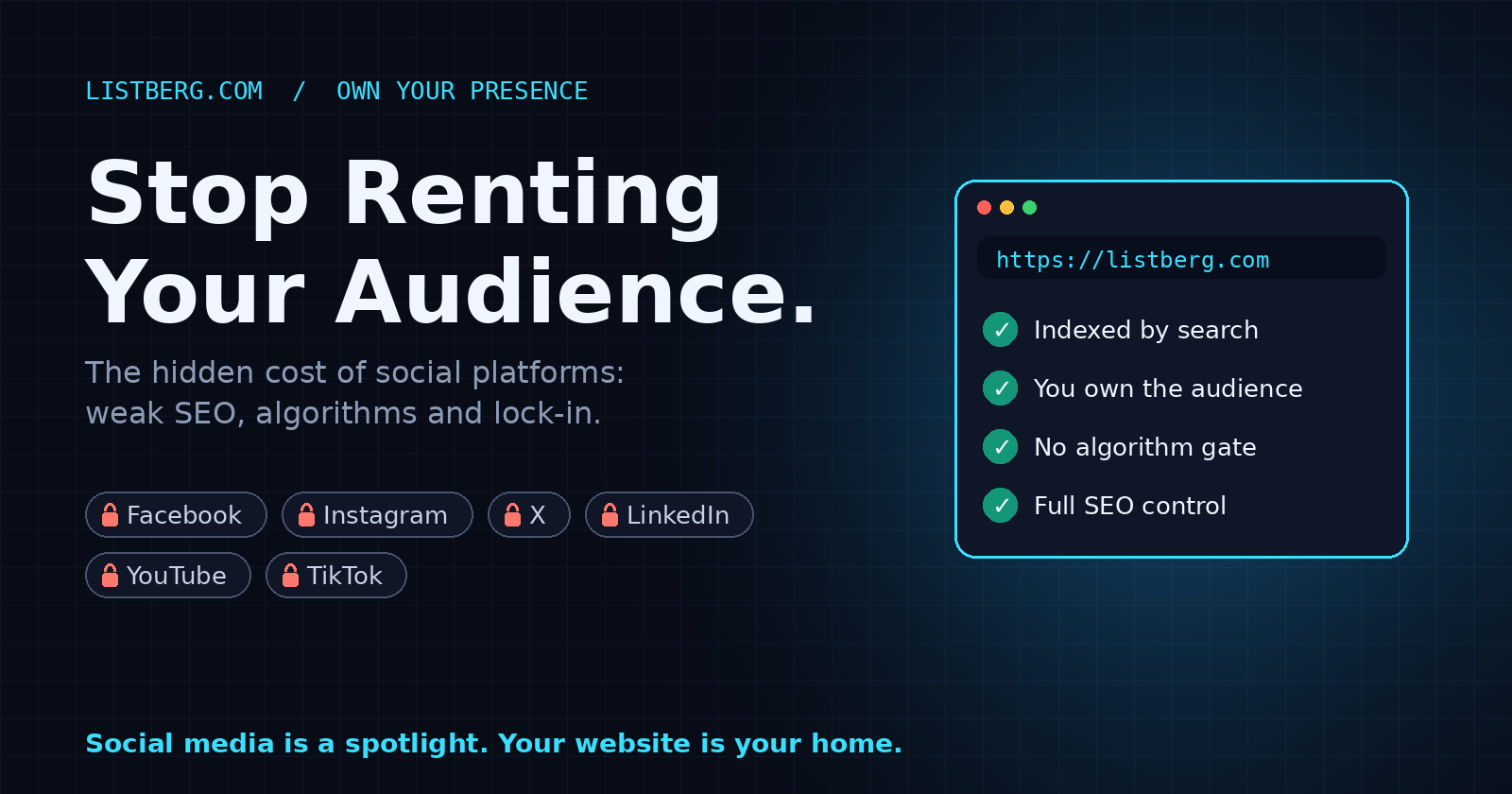
You do not have to quit social media. Use it as a spotlight, not a home:
- Post on social platforms to reach people.
- Point every post back to a place you own.
- Build your lasting content, offers and authority on your own site.
- Collect emails and direct contacts so you never depend on one algorithm.
Social platforms are rented stages. Listberg.com is a place of your own. Build where you own the foundation.
Ready to build your own presence? Visit Listberg.com.