
India’s Top 100 FMCG Grocery Products and Brands: The Brands Shaping Everyday Indian Consumption
9/25/2026
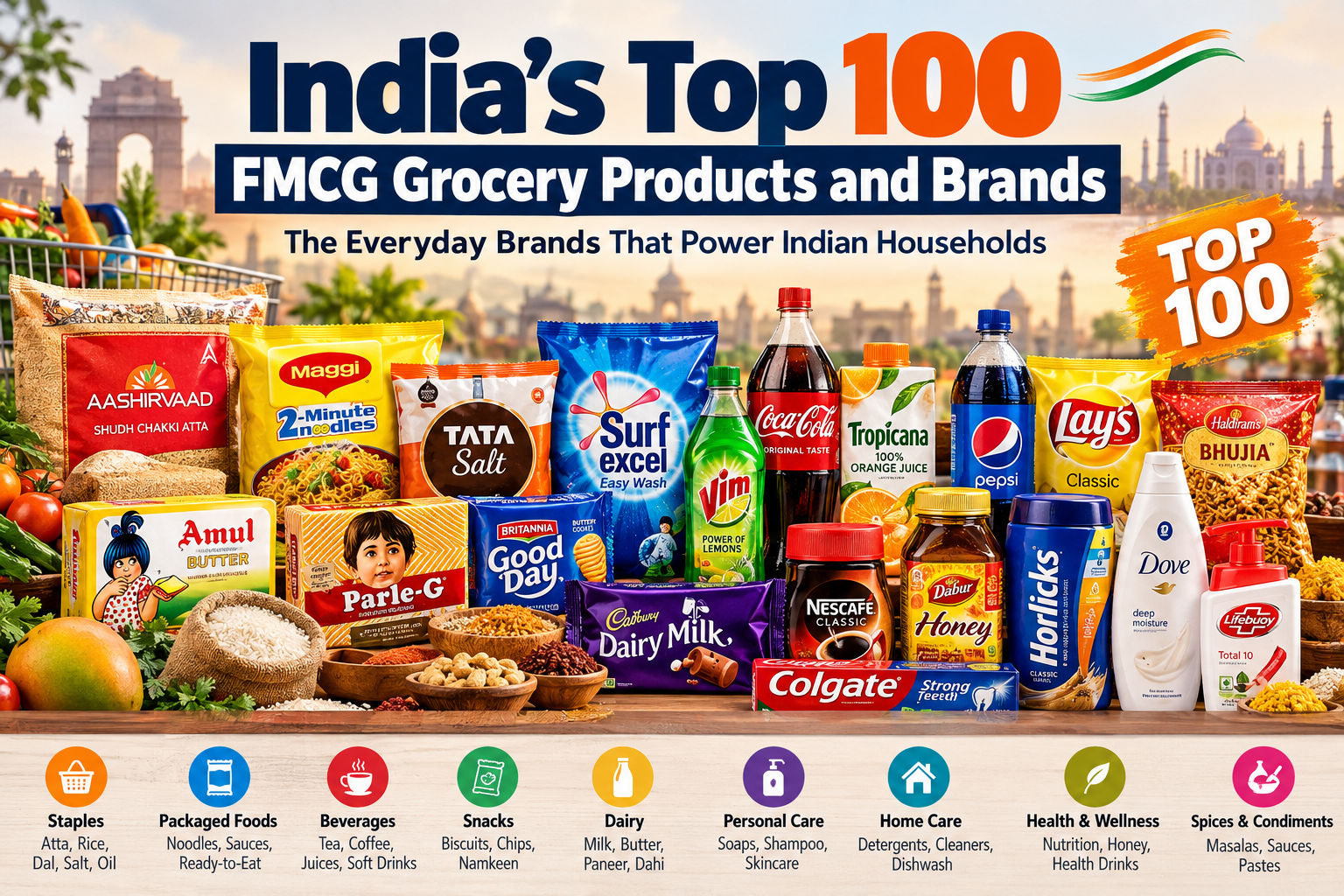
India’s grocery basket is a fascinating combination of habit, affordability, convenience, regional taste and brand trust. From Amul Butter and Tata Salt to Maggi noodles, Parle-G biscuits, Surf Excel, Coca-Cola, Lay’s and Aashirvaad Atta, some products have become so deeply embedded in everyday life that their brand names are often more recognizable than the categories they represent.
The Indian FMCG — fast-moving consumer goods — market is also undergoing a structural transformation. Consumers are buying through traditional kirana stores, supermarkets, modern retail, e-commerce marketplaces and increasingly through quick-commerce platforms. NIQ reported in August 2026 that e-commerce had reached 7% of FMCG sales nationally, while modern trade and e-commerce were increasingly contributing incremental growth.
Against this backdrop, this Listberg guide brings together 100 important FMCG and grocery products and brands used or encountered by Indian consumers, spanning staples, packaged foods, beverages, dairy, snacks, home care, personal care, breakfast products, spices and selected Goa-relevant specialty products.
Important note: The ranking below follows the supplied Listberg dataset and should be understood as a curated list of prominent FMCG/grocery products, not an independently audited ranking by national sales, market share or revenue.
The 100 FMCG Grocery Products at a Glance
| Rank | Product / Brand | Category | Key Manufacturer |
| 1 | Amul Butter | Dairy | GCMMF (Amul) |
| 2 | Maggi 2-Minute Noodles | Packaged Foods | Nestlé India |
| 3 | Surf Excel Detergent | Home Care | Hindustan Unilever |
| 4 | Britannia Good Day Biscuits | Bakery & Biscuits | Britannia Industries |
| 5 | Parle-G Biscuits | Bakery & Biscuits | Parle Products |
| 6 | Aashirvaad Shudh Chakki Atta | Staples | ITC Limited |
| 7 | Tata Salt | Staples | Tata Consumer Products |
| 8 | Nescafé Classic Coffee | Beverages | Nestlé India |
| 9 | Colgate Dental Cream | Oral Care | Colgate-Palmolive |
| 10 | Dettol Liquid Handwash | Personal Care | Reckitt Benckiser |
| 11 | Haldiram's Bhujia Sev | Snacks | Haldiram Snacks |
| 12 | Cadbury Dairy Milk | Chocolates | Mondelez India |
| 13 | Fortune Mustard Oil | Staples | Adani Wilmar |
| 14 | Brooke Bond Red Label Tea | Beverages | Hindustan Unilever |
| 15 | Dabur Honey | Health & Wellness | Dabur India |
| 16 | Saffola Gold Cooking Oil | Staples | Marico Limited |
| 17 | Lux Toilet Soap | Personal Care | Hindustan Unilever |
| 18 | Dove Cream Beauty Bar | Personal Care | Hindustan Unilever |
| 19 | Vim Dishwash Gel | Home Care | Hindustan Unilever |
| 20 | Clinic Plus Shampoo | Personal Care | Hindustan Unilever |
| 21 | Lifebuoy Soap | Personal Care | Hindustan Unilever |
| 22 | Pepsodent Toothpaste | Oral Care | Hindustan Unilever |
| 23 | Head & Shoulders Shampoo | Personal Care | Procter & Gamble |
| 24 | Pantene Shampoo | Personal Care | Procter & Gamble |
| 25 | Gillette Mach3 Razor | Personal Care | Procter & Gamble |
| 26 | Lizol Floor Cleaner | Home Care | Reckitt Benckiser |
| 27 | Harpic Bathroom Cleaner | Home Care | Reckitt Benckiser |
| 28 | Comfort Fabric Conditioner | Home Care | Hindustan Unilever |
| 29 | Rin Detergent Bar | Home Care | Hindustan Unilever |
| 30 | Wheel Detergent Powder | Home Care | Hindustan Unilever |
| 31 | Sunlight Detergent | Home Care | Hindustan Unilever |
| 32 | Taj Mahal Tea | Beverages | Hindustan Unilever |
| 33 | Lipton Green Tea | Beverages | Hindustan Unilever |
| 34 | Bru Instant Coffee | Beverages | Hindustan Unilever |
| 35 | Kissan Tomato Ketchup | Packaged Foods | Hindustan Unilever |
| 36 | Knorr Soups | Packaged Foods | Hindustan Unilever |
| 37 | Kwality Wall's Ice Cream | Dairy | Hindustan Unilever |
| 38 | Amul Taaza Milk | Dairy | GCMMF (Amul) |
| 39 | Amul Masti Dahi | Dairy | GCMMF (Amul) |
| 40 | Mother Dairy Paneer | Dairy | Mother Dairy |
| 41 | Sunfeast Dark Fantasy | Bakery & Biscuits | ITC Limited |
| 42 | Bingo! Potato Chips | Snacks | ITC Limited |
| 43 | Kurkure Masala Munch | Snacks | PepsiCo India |
| 44 | Lay's Potato Chips | Snacks | PepsiCo India |
| 45 | Uncle Chipps | Snacks | PepsiCo India |
| 46 | Pepsi | Beverages | PepsiCo India |
| 47 | Coca-Cola | Beverages | Coca-Cola India |
| 48 | Thums Up | Beverages | Coca-Cola India |
| 49 | Sprite | Beverages | Coca-Cola India |
| 50 | Maaza Mango Drink | Beverages | Coca-Cola India |
| 51 | Frooti | Beverages | Parle Agro |
| 52 | Paper Boat Aam Panna | Beverages | Hector Beverages |
| 53 | Real Fruit Power Juice | Beverages | Dabur India |
| 54 | Tropicana Juice | Beverages | PepsiCo India |
| 55 | Yakult Probiotic Drink | Dairy | Yakult Danone |
| 56 | Horlicks Health Drink | Health & Wellness | Hindustan Unilever |
| 57 | Boost Health Drink | Health & Wellness | Hindustan Unilever |
| 58 | Bournvita | Health & Wellness | Mondelez India |
| 59 | Complan | Health & Wellness | GlaxoSmithKline (Consumer) |
| 60 | Pediasure | Health & Wellness | Abbott Nutrition |
| 61 | Kellogg's Corn Flakes | Breakfast Cereals | Kellogg India |
| 62 | Banganapalli Mangoes | Fresh Produce | Local Goan Mandi |
| 63 | Goan Cashews (W320 Roasted) | Goan Specialty / Snacks | Local Goan Processors |
| 64 | Go Fresh Wafers | Goan Specialty / Snacks | Go Fresh |
| 65 | Goanfest Aam Panha | Goan Specialty / Beverages | Goanfest |
| 66 | Costa Coffee Beans (Local Goa Roast) | Beverages | Costa Country Roasters |
| 67 | Bakers Cocoa Powder | Baking Staples | Bakers India |
| 68 | Blue Bird Jelly Crystals | Dessert Mixes | Blue Bird |
| 69 | Weikfield Baking Powder | Baking Staples | Weikfield |
| 70 | Ching's Secret Soy Sauce | Condiments | Capital Foods |
| 71 | Smith & Jones Ginger Garlic Paste | Condiments | Capital Foods |
| 72 | Maggi Hot & Sweet Sauce | Condiments | Nestlé India |
| 73 | Top Ramen Noodles | Packaged Foods | Nissin Foods |
| 74 | Wai Wai Noodles | Packaged Foods | CG Foods |
| 75 | Ching's Secret Hakka Noodles | Packaged Foods | Capital Foods |
| 76 | Catch Spices Turmeric Powder | Spices & Seasonings | DS Group |
| 77 | Everest Garam Masala | Spices & Seasonings | Everest Spices |
| 78 | MDH Kitchen King Masala | Spices & Seasonings | Mahashian Di Hatti |
| 79 | Badshah Biryani Masala | Spices & Seasonings | Badshah Masala |
| 80 | Eastern Sambar Powder | Spices & Seasonings | Eastern Condiments |
| 81 | MTR Ready to Eat Poha | Instant Foods | MTR Foods |
| 82 | Gits Gulab Jamun Mix | Dessert Mixes | Gits Food Products |
| 83 | Bambino Roasted Vermicelli | Staples | Bambino Agro |
| 84 | Pillsbury Chakki Atta | Staples | General Mills |
| 85 | Rajdhani Besan | Staples | Rajdhani Group |
| 86 | Tata Sampann Toor Dal | Staples | Tata Consumer Products |
| 87 | 24 Mantra Organic Moong Dal | Organic Staples | Sresta Natural Bioproducts |
| 88 | Daawat Rozana Basmati Rice | Staples | Adani Wilmar |
| 89 | India Gate Basmati Rice Feast | Staples | KRBL Limited |
| 90 | Kohinoor Charminar Rice | Staples | Adani Wilmar |
| 91 | Saffola Oats | Breakfast Cereals | Marico Limited |
| 92 | Bagrry's Muesli | Breakfast Cereals | Bagrry's India |
| 93 | Quaker Oats | Breakfast Cereals | PepsiCo India |
| 94 | Act II Popcorn | Snacks | Conagra Brands |
| 95 | Parachute Coconut Hair Oil | Personal Care | Marico Limited |
| 96 | Bajaj Almond Drops Hair Oil | Personal Care | Bajaj Consumer Care |
| 97 | Nivea Soft Cream | Personal Care | Nivea India |
| 98 | Pond's Talcum Powder | Personal Care | Hindustan Unilever |
| 99 | Glow & Lovely Cream | Personal Care | Hindustan Unilever |
| 100 | Vaseline Intensive Care Lotion | Personal Care | Unilever |
What This List Tells Us About Indian FMCG Consumption
A list of 100 everyday products is more than a shopping catalogue. It reveals how Indian households consume, how brands compete and how India's retail market is evolving.
1. Staples remain the foundation of the grocery basket
Products such as atta, rice, dal, salt, edible oil, besan and vermicelli represent some of the most fundamental elements of Indian food consumption.
Aashirvaad, Tata Salt, Fortune, Saffola, Tata Sampann, Daawat, India Gate, Kohinoor, Rajdhani and Bambino illustrate an important shift in Indian grocery retail: consumers increasingly purchase products that were historically treated as commodities through branded channels.
Branding staples allows manufacturers to compete on attributes beyond price — including purity, sourcing, packaging, consistency, nutrition, convenience and perceived quality.
This is particularly important in a market where affordability remains critical. NIQ's recent research highlights the continuing importance of pricing and pack architecture, including small price points, in shaping FMCG demand.
2. Convenience has become a category of its own
Maggi noodles, Top Ramen, Wai Wai, MTR Ready to Eat Poha, Ching's Secret Hakka Noodles and Knorr Soups demonstrate how convenience has become deeply integrated into Indian food consumption.
The attraction is not simply speed.
Convenience products reduce:
- Preparation time
- Cooking complexity
- Ingredient requirements
- Household planning effort
- Cleanup
- The need for specialized cooking skills
This creates a powerful value proposition for students, working professionals, young families and increasingly time-constrained urban households.
The evolution of FMCG therefore isn't simply about consumers buying more products. It is also about outsourcing parts of household work to packaged products.
3. India is simultaneously a tea, coffee and beverage market
The beverage section of the list is particularly diverse.
It contains traditional tea brands such as:
- Brooke Bond Red Label
- Taj Mahal Tea
- Lipton Green Tea
Coffee products such as:
- Nescafé Classic
- Bru Instant Coffee
- Locally roasted coffee
And ready-to-drink beverages including:
- Coca-Cola
- Thums Up
- Sprite
- Pepsi
- Maaza
- Frooti
- Paper Boat Aam Panna
- Real Fruit Power
- Tropicana
This diversity reflects India's transition from a relatively traditional hot-beverage market toward a much broader beverage ecosystem.
Consumers can now choose based on caffeine, refreshment, fruit content, nostalgia, health positioning, convenience, premiumization or regional flavour.
4. Dairy is moving beyond basic milk
India's dairy consumption is increasingly diversified.
The list includes:
- Amul Butter
- Amul Taaza Milk
- Amul Masti Dahi
- Mother Dairy Paneer
- Kwality Wall's Ice Cream
- Yakult Probiotic Drink
This illustrates the transformation from basic dairy consumption toward value-added dairy.
Butter, paneer, yogurt, ice cream and probiotic drinks can command different price points and consumption occasions compared with liquid milk.
India's large dairy ecosystem also gives domestic brands an important advantage: dairy products can combine strong distribution with high levels of consumer familiarity.
IBEF reports that India's milk production rose from 230.58 million tonnes in 2022–23 to 239.30 million tonnes in 2023–24.
5. Snacks are becoming increasingly important
Indian consumers have an enormous appetite for snacks — from traditional namkeen to potato chips, popcorn and packaged western-style snacks.
This list includes:
- Haldiram's Bhujia Sev
- Bingo!
- Kurkure
- Lay's
- Uncle Chipps
- Act II Popcorn
- Goan cashews
The interesting feature of this category is the coexistence of traditional Indian taste and modern packaged formats.
Namkeen and bhujia compete in the same broad snacking occasion as chips and extruded snacks, but their flavour profiles and cultural associations are very different.
The Indian snack market is also seeing increasing competition from regional, startup and new-age brands. IBEF reports that India's snack market is expected to expand substantially over the coming years, while newer players continue challenging established brands.
6. Home care demonstrates the power of habitual consumption
Surf Excel, Vim, Lizol, Harpic, Comfort, Rin, Wheel and Sunlight occupy an important part of the list.
Home-care products have an unusual characteristic: high purchase frequency combined with strong brand habits.
Consumers may experiment with a new snack or beverage relatively easily, but switching laundry detergent, dishwashing products or toilet cleaners can require a stronger perceived reason.
This makes distribution, availability, pricing and brand familiarity particularly important.
It also explains why large FMCG companies invest heavily in extensive distribution networks.
7. Personal care is an enormous FMCG battleground
The list contains a broad range of personal-care products:
- Lux
- Dove
- Lifebuoy
- Clinic Plus
- Head & Shoulders
- Pantene
- Gillette
- Parachute
- Bajaj Almond Drops
- Nivea
- Pond's
- Vaseline
- Glow & Lovely
Unlike many staples, personal-care products provide considerable room for premiumization and differentiation.
Consumers can choose products based on fragrance, hair type, skin type, ingredients, beauty positioning, perceived efficacy and lifestyle.
This makes personal care one of the most innovation-intensive areas of FMCG.
NIQ reported that Home and Personal Care consumption has shown stronger momentum than food in several recent periods, illustrating the increasing importance of non-food FMCG categories.
8. The Indian grocery market is both national and intensely regional
One of India's biggest FMCG characteristics is the coexistence of national brands with regional preferences.
A consumer may purchase:
National brands
- Tata Salt
- Maggi
- Coca-Cola
- Surf Excel
- Parle-G
while simultaneously preferring:
Regional products
- Eastern Sambar Powder
- Goan cashews
- Local mangoes
- Regional snacks
- Local spice blends
This creates a fragmented but highly resilient market.
For FMCG companies, winning India is therefore rarely just about creating one national product. It often requires adapting flavour, pack size, price point, distribution and communication to different regions.
9. Goa adds another layer to the FMCG story
The supplied list deliberately includes several Goa-relevant products, such as Goan cashews, Goan beverages and locally processed products.
This is useful because Goa demonstrates how national FMCG consumption intersects with:
- Tourism
- Hospitality
- Local agriculture
- Imported and premium food products
- Regional specialties
- Modern retail
- Small local manufacturers
A grocery shelf in Goa can contain mainstream Indian FMCG brands alongside products aimed specifically at tourists, expatriates, hospitality businesses and local consumers.
That combination makes Goa an interesting micro-market within India's broader consumer economy.
10. The retail channel is changing rapidly
The traditional Indian FMCG model depended heavily on the kirana store.
That model remains important, but it now operates alongside:
- Supermarkets
- Modern trade
- E-commerce
- Quick commerce
- Direct-to-consumer websites
- Brand marketplaces
NIQ reported in its Q4 2025 snapshot that e-commerce represented 18% of FMCG sales in India's top eight metros, while quick commerce accounted for more than three-quarters of e-commerce FMCG sales in that period.
By Q2 2026, NIQ reported that e-commerce represented 7% of FMCG sales nationally, providing the first national-level view of its share.
This has major implications for the products in this list.
A consumer searching for detergent, coffee, snacks or shampoo online is no longer restricted to whatever happens to be available at the nearest shop.
Digital shelves are effectively expanding consumer choice.
11. Pack size matters almost as much as product choice
One of the most important characteristics of Indian FMCG is the ability to sell the same product across multiple price points.
A consumer might purchase:
- A small trial pack
- A ₹10 or ₹20 impulse pack
- A medium family pack
- A large-value pack
This allows brands to address very different household budgets without creating entirely different products.
NIQ has repeatedly highlighted unit growth and smaller pack preferences as an important feature of recent FMCG consumption patterns in India.
For FMCG companies, pack architecture is therefore a strategic tool, not merely a packaging decision.
12. Large corporations still dominate — but smaller brands are gaining ground
The 100-product list demonstrates the scale of India's established FMCG companies.
Hindustan Unilever appears across numerous categories, including personal care, home care, beverages and packaged foods.
Other major players represented include:
- ITC
- Nestlé India
- PepsiCo India
- Coca-Cola India
- Marico
- Tata Consumer Products
- Dabur
- Reckitt
- Procter & Gamble
- Mondelez
- Adani Wilmar
However, the competitive landscape is becoming more fragmented.
NIQ reported that small manufacturers were growing faster than larger players in several recent periods, while new-age consumer brands have also been gaining attention through digital commerce and quick commerce.
This creates a fascinating FMCG paradox:
Distribution still favours large companies, but digital discovery is lowering some barriers to entry.
The 100 Products by Category
Looking at the supplied dataset by category gives another useful perspective.
Beverages — 15 products
The largest category in this list includes tea, coffee, carbonated drinks, juices, mango beverages and functional drinks.
Key examples include Nescafé, Red Label, Taj Mahal, Bru, Coca-Cola, Thums Up, Sprite, Maaza, Frooti and Real.
Personal Care — 14 products
This category includes soaps, shampoos, shaving products, hair oils, creams, lotions and other personal-care products.
It features brands such as Dove, Lux, Lifebuoy, Pantene, Head & Shoulders, Gillette, Parachute, Nivea and Vaseline.
Staples — 11 products
Atta, rice, dal, salt, oil, besan and vermicelli form the core of this category.
Notable brands include Aashirvaad, Tata Salt, Fortune, Tata Sampann, Daawat, India Gate, Kohinoor, Rajdhani and Bambino.
Home Care — 8 products
Surf Excel, Vim, Lizol, Harpic, Comfort, Rin, Wheel and Sunlight illustrate the breadth of India's household-cleaning market.
Dairy — 6 products
Amul, Mother Dairy, Kwality Wall's and Yakult represent several different dairy consumption occasions.
Snacks — 6 products
Haldiram's, Bingo!, Kurkure, Lay's, Uncle Chipps and Act II represent the modern packaged-snacking ecosystem.
Packaged Foods — 6 products
Maggi, Kissan, Knorr, Top Ramen, Wai Wai and Ching's Secret demonstrate the popularity of convenience-oriented packaged foods.
Health & Wellness — 6 products
Dabur Honey, Horlicks, Boost, Bournvita, Complan and PediaSure illustrate the long-standing Indian market for nutrition-positioned consumer products.
Spices & Seasonings — 5 products
Catch, Everest, MDH, Badshah and Eastern reflect the importance of regional and national spice brands.
Breakfast Cereals — 4 products
Kellogg's, Saffola, Bagrry's and Quaker represent India's expanding packaged-breakfast segment.
Other categories include bakery and biscuits, condiments, oral care, dessert mixes, baking products, instant foods, organic staples and Goa-specific products.
What Makes an FMCG Brand Successful in India?
The 100 products reveal several recurring characteristics.
1. Availability
A product cannot become a mass-market FMCG brand if consumers cannot find it.
Distribution remains one of the strongest competitive advantages of established companies.
2. Affordable entry points
Small packs allow consumers to experiment with products without committing to a large purchase.
3. Habit
Once a product becomes part of a household routine, switching becomes less frequent.
4. Trust
Food, personal care and household products often involve perceived quality and safety considerations. Brand familiarity therefore has significant value.
5. Regional relevance
Indian consumers have highly differentiated food preferences. National scale does not eliminate regional taste.
6. Innovation
Successful FMCG portfolios continuously introduce new flavours, formats, pack sizes, variants and premium products.
7. Digital discoverability
E-commerce and quick commerce are making product discovery increasingly important, particularly in urban markets.
The Next Phase of Indian FMCG
India's FMCG industry is entering a period where distribution, affordability, premiumization and digital commerce will increasingly intersect.
The traditional mass-market strategy — sell a standardized product everywhere — is becoming only one part of the equation.
Future growth is likely to involve increasingly precise segmentation:
₹10 product → mass-market consumer
Family pack → value-conscious household
Premium variant → affluent consumer
Health-focused variant → wellness-oriented consumer
Regional flavour → localized demand
Quick-commerce SKU → immediate consumption
D2C product → niche consumer segment
This segmentation is already visible in the rapid expansion of digital commerce and the emergence of smaller consumer brands.
Final Takeaway
The 100 products in this list demonstrate why Indian FMCG is one of the world's most interesting consumer markets.
The market is not driven by a single type of consumer or a single retail channel.
It is simultaneously:
- Traditional and digital
- Mass-market and premium
- National and regional
- Price-sensitive and aspirational
- Habit-driven and innovation-driven
- Kirana-led and increasingly e-commerce-enabled
Products such as Amul Butter, Maggi, Surf Excel, Parle-G, Tata Salt and Aashirvaad represent the strength of established consumer habits. Meanwhile, regional products, premium offerings, digital-first brands and quick-commerce distribution are continually expanding the boundaries of what Indian consumers can discover and purchase.
For consumers, this means greater choice.
For retailers, it means more complex assortments.
For manufacturers, it means increasingly sophisticated competition.
And for anyone studying India's consumer economy, the FMCG shelf offers something remarkably valuable: a real-time snapshot of how Indian households live, eat, clean, work, travel and spend.
As India's consumption economy continues to evolve, the most interesting question may no longer be simply which brands dominate the shelf?
It may be:
Which brands can remain relevant as the Indian consumer, the Indian household and the Indian retail channel continue to change?