
Rethinking the Meaning of a Majority: Need for Voting Reforms
9/6/2026
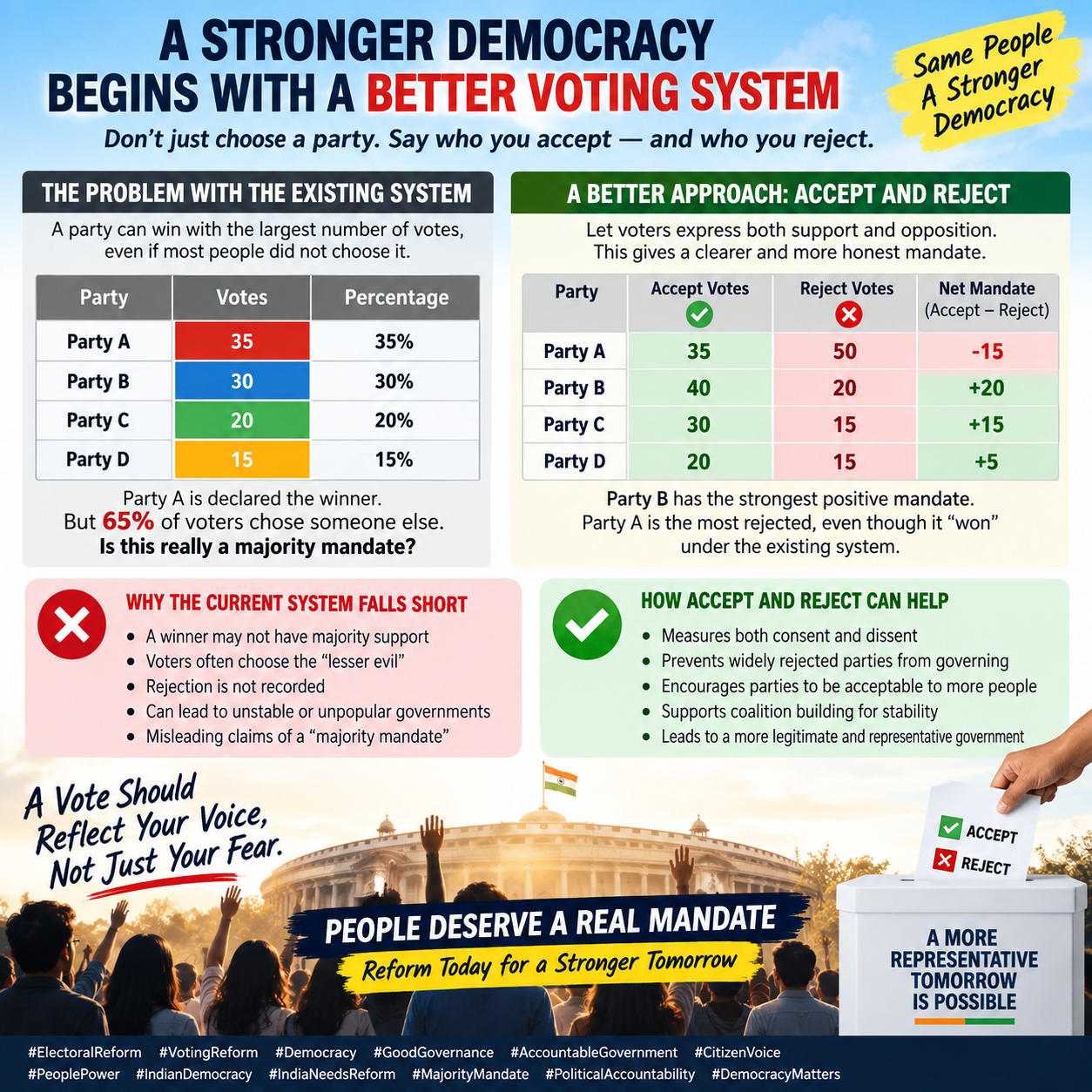
I wish to draw attention to a fundamental weakness in the way we understand and conduct elections. We often describe the winning party as having received a “majority mandate”, when in reality, in many elections, it has received only a plurality the largest share of votes among several competing parties.
Consider a simple example of 100 voters and four political parties. Party A receives 35 votes, Party B 30, Party C 20 and Party D 15. Under the existing system, Party A is declared the winner. Yet 65 voters did not select Party A. How, then, can 35 votes be described as a majority mandate?
This is not merely a mathematical technicality. It has profound consequences for democratic legitimacy. When several parties divide the electorate, a party can obtain governmental power with the support of a relatively small proportion of the total electorate. The winner may have won the election, but it does not necessarily follow that the winner has won the confidence of the majority.
There is another problem that our present voting system fails to capture: rejection.
A citizen may vote for Party B not because they genuinely support Party B, but because they want to prevent Party A from coming to power. The ballot records the selection of B but completely conceals the rejection of A.
Why not therefore redesign the ballot to record both?
I propose an Accept-and-Reject Voting System in which voters are given the opportunity to express two distinct democratic judgments: first, which party or parties they are willing to accept as a government; and second, which party they explicitly reject. For example:
Party| Accept Votes| Reject Votes| Net Mandate
A| 35| 50| -15
B| 40| 20| +20
C| 30| 15| +15
D| 20| 15| +5
Under the present system, Party A would be the winner because it has the largest number of selection votes. But the second column tells a very different story. Party A is rejected by half the electorate, while Party B enjoys the strongest positive balance between acceptance and rejection.
Such a system could establish a simple constitutional principle: winning should require not merely being the largest party, but demonstrating sufficient public acceptance while not being overwhelmingly rejected.
This could also encourage political parties to broaden their appeal. Instead of concentrating exclusively on securing a loyal minority, parties would have an incentive to become acceptable to a wider section of society. Coalition governments, where necessary, could then be formed between parties that collectively possess a positive and sufficiently broad mandate.
This proposal is not about eliminating political competition or preventing voters from choosing their preferred party. It is about recognising that democracy consists of both consent and dissent.
Our present ballot essentially asks: “Who do you choose?” It does not adequately ask: “Who do you reject?”
Both answers matter.
A government should not be considered democratically strong merely because it finished first in a divided contest. A party receiving 35 percent of the vote while 65 percent vote for alternatives has certainly won the election under the existing rules, but claiming that it has received a majority mandate is misleading.
Perhaps it is time to rethink what we mean by a democratic mandate.
The future of electoral reform should not merely be about identifying a winner. It should be about measuring acceptance, recognising rejection, and ensuring that those who govern possess a genuine and sufficiently broad mandate of the people.
Yours faithfully, A Concerned Citizen